
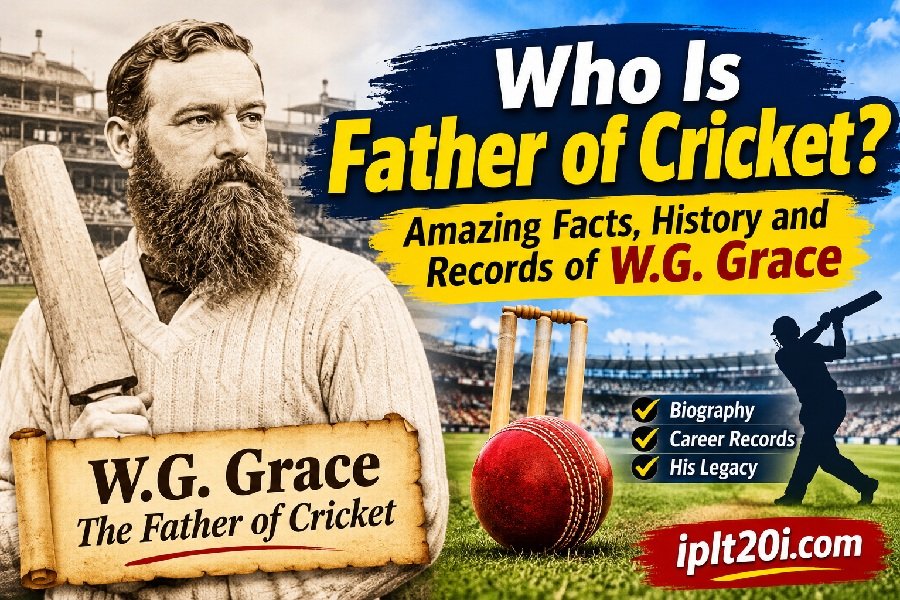

Who is father of cricket? Well, this is where W.G. Grace comes into the picture. William Gilbert Grace was born on 18th July, 1848 in Downend, Bristol and was the most popular cricketer of his era.
Cricket has come a long way. From the traditional English games, to modern day competitions like the Indian Premier League. With cricketing countries producing new talent, the more savvy cricket viewers can appreciate the game more and remember the legendary players like W.G. Grace who shaped and moulded cricket into a game of this scale.
Who Is Father of Cricket in The World?
W.G. Grace is referred to as Father of Cricket in the World. As mentioned earlier he was born on the 18th of July, 1848 in Downend, Bristol, England. His all-round sportsmanship with exceptional batting and bowling ability made him an even greater sportsman. He singlehandedly took cricket to a whole new level of popularity. The ICC (International Cricket Council) states that Grace was a game changer in terms of batting, and played an pivotal role for cricket’s mass popularity.
In 22 Test matches, he proudly donned the English colours. For over 40 years, he graced the first-class game. His legend stretches far beyond the career stats he amassed. He was instrumental in building the legacies of the game’s greatest players, and in changing how the game was looked upon by the fans.
W.G. Grace Biography & Personal Details
Some important aspects of the legendary player are highlighted in the table below.
| Detail | Information |
|---|---|
| Full Name | William Gilbert Grace |
| Popular Name | W.G. Grace |
| Date of Birth | 18 July 1848 |
| Place of Birth | Downend, near Bristol, England |
| Nationality | English |
| Role | All-rounder |
| Batting Style | Right-handed |
| International Team | England |
| Test Matches | 22 |
| Date of Death | 23 October 1915 |
| Famous Title | Father of Cricket |
Apart from those mentioned above, W.G. Grace’s long and illustrious career helped define several landmark eras of the game. Some of his achievements remain unmatched and continue to provide benchmarks for the game’s players.
Why Is W.G. Grace Called the Father of Cricket?
There are various reasons why W.G. Grace is bestowed with this title.
1. He Revolutionised Batting
An all-rounder par excellence, W.G. Grace was a master at both batting and bowling. He led the English side for 6 years. During his early days of cricket, the game was rapidly changing, and he personified the new style of batting. As previously batting was considered a duty, he instilled a sense of class and pride in batting.
2. He Played Cricket for More Than 40 Years
Grace played professional cricket for a record spanning 44 years. He played first class cricket from 1865 to 1908. During this long period, he played a record 44 first class matches.
3. He Made Cricket More Popular
Playing at a high level for such a long time shows his dedication to the game as well as his adaptability. His long career helped to keep the public interested in the sport.
4. He Excelled as an All-Rounder
In the Victorian Era, Grace was one of the most famous sportsmen in England. Fans came to watch him bat rather than the game.
With popularity like Grace’s, cricket players were able to become famous and cricketers were able to get paid to play. He was important for the development of the sport.
Although Grace was known more for his batting, he was also a great bowler, and both helped his team.
Grace’s batting and bowling combined with his all-around performance made him very versatile and a threat on the pitch.
W.G. Grace Cricket Career and Records
Grace’s records and statistics show his greatness and why he is known as one of the best to ever play the game.
| Cricket Record | Achievement |
|---|---|
| First-class matches | 870 |
| First-class runs | 54,211 |
| First-class wickets | 2,809 |
| Test matches | 22 |
| Test runs | 1,098 |
| Test centuries | 2 |
| First-class career | 1865–1908 |
These figures are based on historical cricket’s records. His first-class career numbers demonstrate his remarkable consistency as both a batter’s and a bowler.
Grace also achieved significant milestones in English cricket. In 1874, he became the first player to complete the seasonal double of 1,000 runs and 100 wickets in English cricket, repeating the achievement in each of the following four seasons.
Who is the Father of Cricket in India?
There are sometimes varying opinions regarding who is the ‘Father of Cricket’ for Indian cricket and world cricket.
For world cricket, it is believed W.G. Grace is the ‘Father of Cricket.’ W.G. Grace not only introduced several rules of the game but also made several improvements as a player, administrator and umpire.
In Indian cricket, Ranjitsinhji was as important as K.S. Ranjitsinhji in the development of Indian cricket and his early international representation.
Ranjitsinhji was born in 1872, and represented England in Test cricket and was famous for his elegant batting style and leg glance. The Ranji trophy, which is the most prestigious of all domestic competitions in India is named after him.
They are historical descriptions, and therefore, their usage may depend on the context.
Difference Between W.G. Grace and Ranjitsinhji
| Feature | W.G. Grace | Ranjitsinhji |
|---|---|---|
| Main association | Father of Cricket | Pioneer of Indian cricket |
| Birth year | 1848 | 1872 |
| Cricket team | England | England |
| Known for | Batting and all-round ability | Elegant batting and leg glance |
| Major legacy | Transforming cricket’s popularity | Influencing Indian cricket history |
| Famous honour | Father of Cricket title | Ranji Trophy named after him |
Both players made valuable contributions to cricket, although their historical roles and legacies were different.
How W.G. Grace Influenced Modern Cricket and the IPL
Grace’s era of cricket is very different from today’s version of the game. The game today is played at a frenetic pace across different forms of the game.
The Indian Premier League (IPL) demonstrates new innovative batting strategies, energetic fast-moving cricket, and pro bowling. The nearness of W.G. Elegance at the beat of the arrange, long some time recently the amusement was changed to an advanced version of T20, changed the way we see batting in cricket.
As a portion of the growing T20 phenomenon, current and previous stars of the Indian Chief Alliance (such as Kohli, Rohit Sharma, and Dhoni) proceed to construct on W.G. Grace’s bequest, motivating another era of cricket-loving fans.
For those fans interested in cricket history the IPL’s player stats and exhibitions, or other related cricket’s subjects they can visit iplt20i.com.
Frequently Asked Questions (FAQs)
1. Who is Father of Cricket?
William Gilbert Grace (or ‘W.G.’ Grace) is known to many as the ‘Father of Cricket’.
2. In what year was W.G. Grace’s born?
W.G. Grace was born in 1848.
3. How many Test’s matches did W.G. Grace play?
W.G. Grace played 18 Test matches.
He represented England in 22 Tests from 1880 to 1899.
4. Who is known as the father of Indian cricket?
While he is closely related to the development of Indian cricket, the worldwide credit for being the father of cricket goes to W.G. Grace.
5. What has made W.G. Grace famous?
He has been famous for being an excellent all-round cricketer, long first-class career and vast contribution to the popularity of the game.
Conclusion
The correct answer to the father of cricket is W.G. Beauty. He is one of the greatest personalities of the diversion within the 19th century and contributed a parcel for the game’s expansion across the globe.
Although modern cricket has a number of energizing designs and associations just like the IPL, pioneers like W.G. Elegance contributed a part to the amusement and molded the cricket of that time. His bequest and commitments are an motivation to the individuals who need to know more about the history of the game.